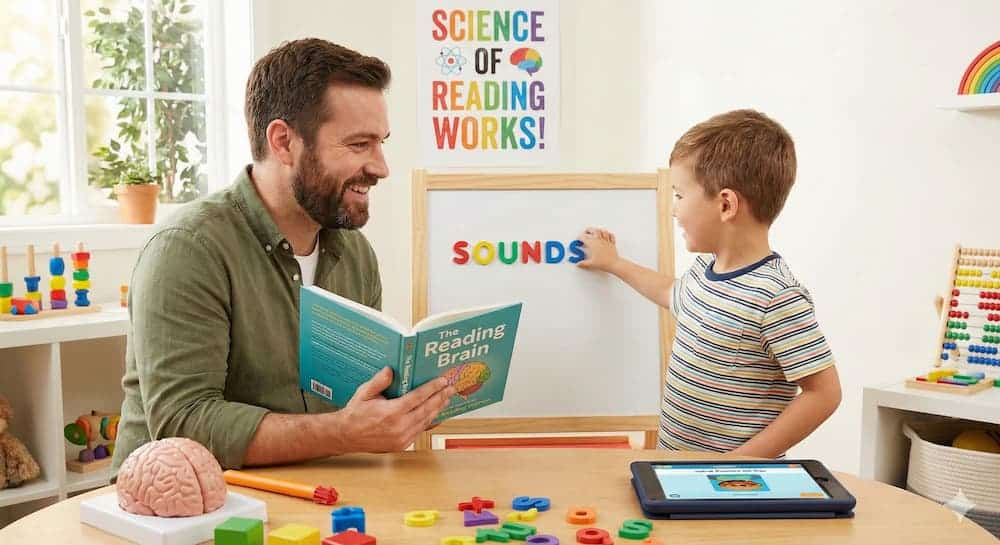
 If you’ve been paying attention to education news lately, you’ve probably heard the phrase “science of reading” mentioned with increasing frequency. School districts across Minnesota and the country are overhauling how they teach children to read, and terms like “structured literacy” and “phonics-based instruction” are showing up in everything from parent newsletters to legislative debates. But what does this actually mean for your child – and why should you care?
The short answer is that decades of research have given us a much clearer picture of how the brain learns to read, and many schools are now aligning their instruction with that evidence. If your child is learning to read right now – or struggling to do so – understanding this shift can help you support them more effectively and advocate for what they need.
Reading Doesn’t Come Naturally
Here’s something that surprises many parents: unlike spoken language, reading is not a skill humans are wired to acquire automatically. Children learn to talk simply by being surrounded by language, but reading requires explicit instruction. The brain must be trained to connect written symbols to sounds, and that process doesn’t happen through osmosis or exposure alone.
For years, a popular approach called “whole language” or “balanced literacy” emphasized exposing children to rich literature and encouraging them to use context clues – like pictures or the first letter of a word – to guess at unfamiliar text. The idea was that reading would develop naturally through immersion, much like speaking does. It sounds intuitive, and it worked reasonably well for some children. But research has consistently shown that this approach fails a significant portion of learners, particularly those with dyslexia or other reading difficulties.
The science of reading refers to the body of research – spanning cognitive psychology, neuroscience, and education – that tells us what actually works. And the evidence is clear: systematic, explicit instruction in phonics and phonemic awareness is essential for building skilled readers.
What Structured Literacy Looks Like
When schools adopt a science of reading approach, instruction typically becomes more structured and sequential. Children learn the relationships between letters and sounds in a deliberate order, practicing until each skill becomes automatic before moving to the next. They’re taught to decode words by sounding them out rather than guessing based on context or pictures.
This doesn’t mean classrooms become joyless drilling factories. Effective structured literacy instruction still includes rich read-alouds, vocabulary development, and comprehension strategies. The difference is that foundational decoding skills are no longer left to chance. Every child receives the explicit teaching their brain needs to crack the code.
One framework you might encounter is LETRS – Language Essentials for Teachers of Reading and Spelling. This professional development program trains educators in the science behind reading acquisition and equips them with strategies to teach all components of literacy effectively. Teachers who complete LETRS training understand not just what to teach, but why it works and how to adapt instruction for students who struggle.
Why This Matters for Your Child
If your child is thriving with reading, the shift toward structured literacy will only strengthen their skills. But if your child has been struggling – stumbling over words, avoiding books, or falling behind peers – this change in approach could be transformative.
Many children who were labeled as “not ready” or “needing more time” under previous methods simply weren’t receiving the type of instruction their brains required. When these same students are taught with explicit, systematic phonics instruction, they often make rapid progress. The research shows that the vast majority of children can learn to read when taught appropriately – including most students with dyslexia.
As a parent, you can support this work at home by reinforcing phonics skills rather than encouraging guessing. When your child encounters an unfamiliar word, prompt them to sound it out rather than look at the picture or skip ahead. Celebrate the effort of decoding even when it’s slow. And if your child continues to struggle despite good instruction, don’t wait – early intervention is far more effective than hoping they’ll catch up on their own.
Finding the Right Support
If your child is behind in reading, working with a tutor trained in structured literacy methods can make a significant difference. Not all tutoring approaches are equal – look for someone who understands the science of reading and uses systematic, evidence-based strategies rather than generic homework help.
The goal isn’t just to get through this week’s reading assignment. It’s to build the foundational skills that will serve your child for life. And thanks to decades of research, we now know exactly how to do that.